
One of the most spectacular plant care activities of the cold season is the whitewashing of tree trunks. Now, why have we been doing all this since our grandfathers?
The first and most important effect is that it can help protect tree trunks from the formation of frost lines. Frost bars, longitudinal cracks in the trunk of trees. The bark of our fruit trees is dark in comparison to the environment, the winter sun warms the southern side, causing the tissues to expand and then contract after sunset. This constant movement causes the tissues to tear and then develop frost lines. These cracks not only block the flow of nutrients, but also open the door for pathogens to enter the deeper tissues of the tree. The whitewashed trunk reflects sunlight, thus stopping this cycle.

Lime also provides a disinfectant effect against certain pathogens and can act as a deterrent for certain pests, such as ants or rabbits.
Misconception, that we can delay the spring emergence of the trees by liming the trunks, as this depends more on the soil temperature.
Should all trees be limed?
Some fruits, such as apricots, peaches, plums and walnuts, are more prone to freezing, but other trees should also be treated. A whitewashed trunk gives a clean, tidy look to the garden. Be careful not to whitewash trunks younger than 3-4 years old. These have a thin layer of dead and decayed wood, through which active respiration is taking place. Liming on young parts can be phytotoxic.

A proven technique
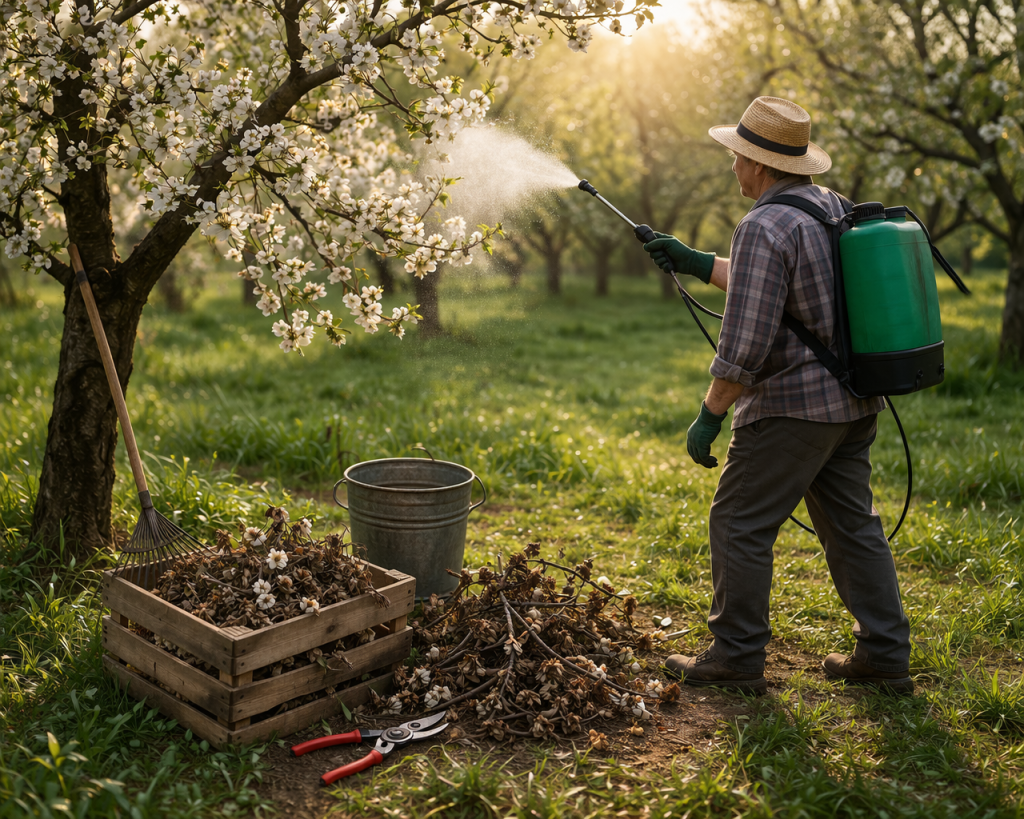
One of the best ways is to from slaked lime with the addition of water to a lime milk of about 5-8%we mix it. However, if a thicker solution is used, lime flakes can form on the bark, which can serve as a hiding place for pests. For more even coverage, application can be done with a sprayer. Wear protective clothing when working as calcium hydroxide is a skin irritant. The liming should be carried out during a period of no precipitation above freezing to allow time for the lime to dry on the trunk. This is best done around November, when the first frosts occur, but as the lime applied to the trunk will provide sufficient coverage for about 1 year, it can be done almost any time of the year.

To protect the trunks of young trees you wouldn't think it, but closed trunk guards (e.g. cardboard plastics) or trunk nets used to protect against herbicides and wildlife damage are perfect. Trunk netting is also available in white, as the white colour reflects light and has a lime-like, trunk cooling effect.

(TREEX, white)
Not all ice cream is what it looks like. In the 1970s, the plum bark rot virus caused significant damage to domestic plum plantations. Thanks to controlled propagation material, it is declining, but we may still encounter it. The infestation causes brown spots to appear on the trunks of trees, which later become sunken and develop heavy bark cracking. Over time, the cracks can penetrate right into the woody part. Such trees have smaller foliage, shed their leaves earlier, grow more slowly and often produce a lot of bark. The primary control is the use of free propagating material.


Photo by Ádám Veller Danuba Garden consultant
💚 Tricho Immun actively protects the internal tissues of plants against most decay pathogenic fungi, even in winter. On the one hand, it produces substances that suppress the growth of other fungi, and on the other hand, it can loop and digest their hyphae. Use after pruning by spraying at 50g/10l on a dry day at temperatures above freezing. The included strains are cold tolerant and cooler weather will not harm them, but they need time to establish within the plant, which can take up to a month.


 English (UK)
  Magyar