

What are humic acids?
The word humic acid means: soil, topsoil. It is an essential component of soil: organic matter in the soil that has undergone humification (the decomposing activity of soil-dwelling fungi and bacteria). It is also the most valuable part of the soil because it serves as the 'home' for beneficial fungi and bacteria. It can absorb up to 100 times its mass in water and is a significant source of nutrients. Humic acids play a crucial role in fertility, as they influence soil structure, water, air, maintaining soil and heat management.
How are organic matters formed in the soil?
The organic matter present in the soil, or that has been deposited in the soil, is gradually broken down by the micro-organisms and inorganic matter living in the soil: this process is called mineralisation, whereby more complex organic matter is first transformed into simpler organic matter and then into substances that plants can absorb (water, carbon dioxide, cations and anions). The humic content of the soil is determined by the amount of organic matter that enters the soil over a period of time and how quickly it decomposes and mineralises.
Rapid and efficient humic acid formation requires strong microbial decomposition activity, followed by occasional cessation of this activity. It is therefore most abundant in the temperate zone. Where there are no obstacles to decomposition, i.e. where organic matter is fully decomposed, no humic acid remains in the soil (e.g. tropical rainforest soils). Where organic matter is not available (e.g. deserts, high mountain ranges), no organic matters are formed.

How can we get organic matter if there is not enough in the soil?
💚 soil organic matter can also be extracted from soil by artificial methods, as well as from peat, lignite, and lignite coal. The best quality organic matter is named after its researcher, Professor Leonard. These Leonardite materials have formed over 10 million years and are mined in only a few places in the world. Leonardite is similar to brown and black coal and is therefore mined in a manner similar to these types of coal. High-quality Leonardite is found in the USA, Canada, and Australia. But, just as the Earth's coal supply is finite, so is the Leonardite supply. The Danuba Garden humic acid products are all Leonardite-based!
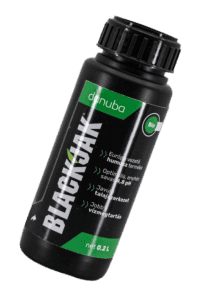
What does Blackjak contain?
It contains at least 28% of organic matter, of which at least 20% are natural humic substances (humic, fulvic, and humic acids), which are natural active substances, biostimulants.
Humic acids - giant organic molecules, excellent soil conditioners
Humic acids, like a bio-chelate (a complex compound in which one component is linked to the other at two or more points in a ring, forming a so-called "scissor" compound), bind water and nutrients in the soil so that they are available as a buffer for the plant's roots later on. The more humic acid there is in the soil, the greater its ability to bind nutrients and water. These complex organic molecules are the most stable part of the soil. Humic acids are soluble in neutral water and alkaline solvents such as potassium hydroxide, but are not soluble in strong acids.
Fulvic acids - bio chelates and biostimulants: enhance nutrient and water absorption
Fulvic acids are about one-tenth the size of humic acids, which are soluble in almost everything (neutral water, acids and alkalis). It is recommended to be applied in the soil as a complex with other humic substances or sprayed on the leaves.
They have an extremely high density of different interfaces on their surface, allowing them to bind other substances, nutrients, or molecules tightly. This bio-chelating effect is extremely important when fulvic acid is applied to foliage or soil, as it can easily carry other substances in the spray through the leaf surface or roots.
Ulmic acids: improves soil structure and nutrient retention
Oleic acids are soluble in alcoholic compounds, not in acids or bases. They are less stable compounds than humic acids.
Humic substances - give stability to your soil
Humic substances are not soluble in water, or even in acids and alkalis. However, it can form up to 50% of the soil's organic matter. This gives it its stability!
Humins are formed from molecules formed during the decomposition of organic materials (e.g. cellulose and lignin) by first breaking down plant residues into very small molecules and then reacting with each other to form giant, stable molecules. These humic compounds, as a kind of fat-like substance, do not dissolve, giving the soil its stability.
The humic compounds increase the anion-binding capacity of the soil, which means that nitrite, nitrate, sulphite and phosphite are retained in the soil in an absorbable form and do not leach out below the root zone!

(According to the University of Padua, Blackjack can increase the uptake of all nutrients)
How is Blackjak different from any other humic acid products on the market? 🏆
Blackjak's pH is, as the only one commercially available, in the optimal range of 4-5, which makes it much more effective than other products using sodium/potassium hydroxide (alkaline) extractants.
Because Blackjak is made without chemical solvents, by physically crushing the best quality Leonardite, it contains all the components that make up hummus! The ingredients in the product
5-10 micron pieces of Leonardite partly float and partly settle to the bottom of the packing as it is a suspension (supersaturated solution). So shake before use!
Unlike Blackjacks, solvent-based hops contain only those hop constituents that can be solvent-dissolved from the raw material. Blackjak leonardite, on the other hand, does not extract or dissolve anything from the base material, but only physically preserves it, thus maintaining a higher active ingredient content.
How does Blackjack help with hops? 🪴
- Organic matter applied to the roots of the plant can significantly increase water and nutrient uptake, thus improving soil quality
- The roots of the plant can absorb more water and nutrients
- Even if the soil is otherwise poorly supplied with organic matter, nutrients or has a poor pH, it can still provide the ideal soil conditions for the roots of the crop in its environment. So its use in poorer soils is almost obligatory!
- Since humic acids can bind not only cations (like clay colloids) but also anions, they improve the utilisation of nitrogen (nitrite, nitrate), phosphorus (phosphite, phosphate) and sulphur (sulphite, sulphate) fertilisers.
- A big problem with liquid nitrogen solutions is that they wash down below the root zone in heavy rain. If Blackjack is added to the fertiliser applied, the organic matter will sponge-like bind most of the nitrogen ions (nitrite and nitrate). This way, it is not leached out, but is supplied to the plant root for several weeks
How do I use Blackjack?
To the soil 🌱
Dosage: 1-2 dl of Blackjack is first shaken well and then mixed in 10 litres of water in a jug or backpack sprayer. The bottle is rinsed 3-4 more times to ensure that any particles that have settled on the bottom and walls are not wasted. The product is black, so care should be taken when applying it to avoid splashing on other surfaces (walls, curtains, paving stones). If it does get on, don't panic, wipe it up quickly to avoid leaving a residue. It can also be used with a drip sprinkler or dispensed by a dispenser.

Frequency: once every 4-6 weeks, but not to be overdosed. If the aim is to improve the soil structure, e.g., if it is too compacted or too loose and sandy, it is advisable to apply a higher dose of up to 1 litre of black liquor per 10 litres of water.
Canopy 🌳
Blackjack, as a biostimulant sprayed on foliage, has the following benefits:
- the small molecules of fulvic acid contained in it easily penetrate the leaf. If other substances are added, such as foliar fertiliser or an absorbable pesticide, they will be absorbed more quickly
- when applied on the Blackjak canopy, it increases the plant's nutrient uptake. As this increases the concentration of nutrients in the plant, it has a sucking effect on the water in the soil. A pump of nutrients and water from the soil into the plant is thus activated! This in turn, results in a larger plant mass
- the result of this water-pumping effect is more intense evaporation, which cools the plant. This cooling of a few degrees results in the plant continuing to photosynthesise and build up its biomass, mass
The disadvantage of foliar treatment is merely its black colour, which will disappear with the next rain or watering. On ornamental plants, however, it is not particularly attractive and is better suited for use on the ground.
The dose and frequency of application is the same as for soil treatment.
Shelf life and storage of Blackjak
5-30 0C in its original packaging for at least 36 months. It should be applied as soon as possible after opening, but stored tightly resealed in a cool, frost-free place for up to 6 months without deterioration.
 Magyar
 English (UK)