

Plants need the highest amounts of macro-nutrients. These are nitrogen (N), phosphorus (P) and potassium (K). However, there are other nutrients that are just as important, but are needed in smaller amounts for the life of plants. These are the micronutrients. We know that micronutrients are important for humans and many of us take them as supplements to keep our immune systems strong. In the 1800s, German scientist Justus von Liebig formulated the law of the minimum, which states that it is always the nutrient in the minimum that will hold back plant growth.

What are these important microelements?
Iron: In the absence of this, the leaves turn yellow and chlorosis develops. A central component of chlorophyll, which binds light during photosynthesis. This is when the plant produces sugar from water and carbon dioxide. Above alkaline pH, above 7, the plant cannot take it up from the soil, so it must be replaced in the leaves. Blueberries, rhododendrons, hydrangeas, grapes, peppers and tomatoes are particularly sensitive to iron deficiency.
Copper: the leaf tips will turn white. It has an important role in enzymatic and hormonal processes.
Zinc: in its absence, the leaves will turn white and remain small. It has an important role in protein and carbohydrate metabolism.
Manganese: in its absence, the plant will be poorly developed. It plays an important role in, for example, photosynthesis and the formation of the plant hormone auxin.
Molybdenum: in its absence, leaves turn yellow and growth may be stunted. It plays a key role in the processing of nitrogen nutrients. Especially in butterfly crops such as beans, peas and brassica, its absence can be fatal.
Boron: in its absence, the growth of the plant will be distorted. It plays an extremely important role in cell wall formation and flowering.

Absorption of nutrients in different soils
The absorption of micronutrients in soil varies with pH. Many gardeners have acidic soils where molybdenum uptake is inhibited. And in alkaline, high pH soils, the uptake of iron and copper and zinc may be inhibited. Boron is also best absorbed at neutral pH around 7.
As the pH of soils is very rarely ideal, some kind of micronutrient deficiency is almost always expected, so a boosting micronutrient foliar fertilisation is recommended.

Doses: 50 ml / 10 litres of water
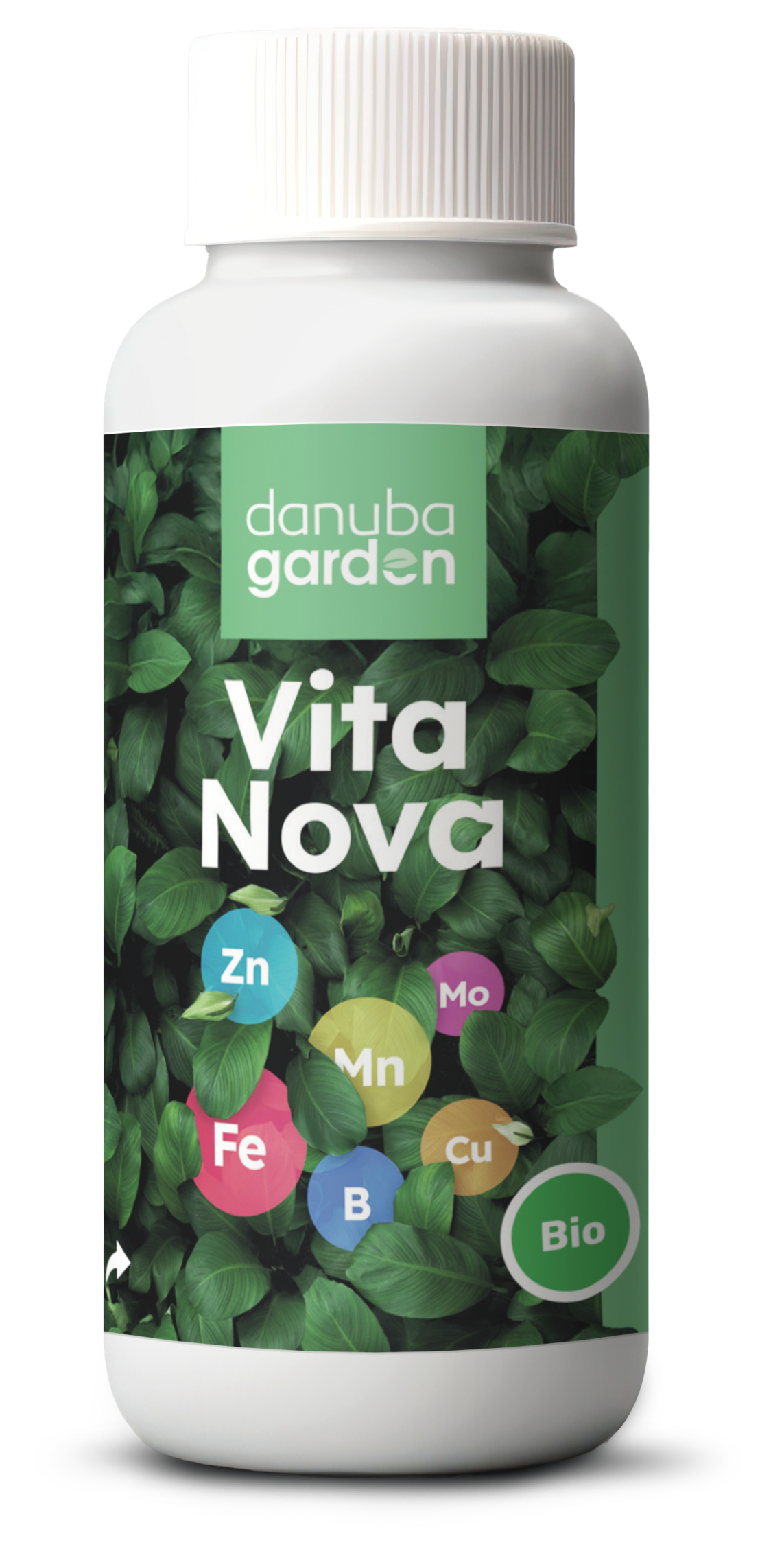
Composition:
- Fe 40 g/l
- Mn 19 g/l
- B 3.8 g/l
- Zn 3.1 g/l
- Cu 1.5 g/l
- Mo 0.77 g/l
pH: 4.0–5.5 (slightly acidic)
Density: 1.28 kg/litre
Storage and shelf life: Store in the original, unopened packaging in a dry, cool place, protected from direct sunlight, at a temperature between 5 and 25 °C. Crystallisation may occur below 5 °C. It has a shelf life of 3 years; once opened, it retains its quality for 6 months.
Interesting facts
The German scientist Justus von Liebig formulated his law of the minimum in the 1800s, which states that plant growth is always limited by the nutrient present in the smallest quantity; it is therefore best to ensure that there is no deficiency of any nutrient, not even a trace element.

 Magyar
 English (UK)