

It is not uncommon for keen hikers and garden lovers to come across an unfamiliar plant on the road, but one that piques their curiosity all the more. In the past, it took a lot of research to identify them from a picture or a specimen. Today, we can also rely on useful plant recognition applications!
Today, artificial intelligence is making its mark in a wide variety of fields, sometimes to our greater, sometimes to our lesser delight.
- One such trend is the increasingly widespread use of quantification apps, which can identify flowers, mushrooms, insects and more with a single image.
- We've just taken the trouble to try seven of the top apps on the App store.

Several apps offer a complex service, not only making decisions, but also diagnosing diseases and providing care assistance. You can set watering reminders or chat to a gardener's chat stick. We've specifically focused only on the decision-making functions.
For the comparison, we took pictures of 13 completely randomly selected but known plants, and then identified them with each application.
Comparison table: plant recognition options
- With green is marked if a plant is correctly identified,
- In yellow, if it is mixed with a closely related species, but at least not (not = highest taxonomic category) at the correct answer level,
- In red, if the decision was very wrong.
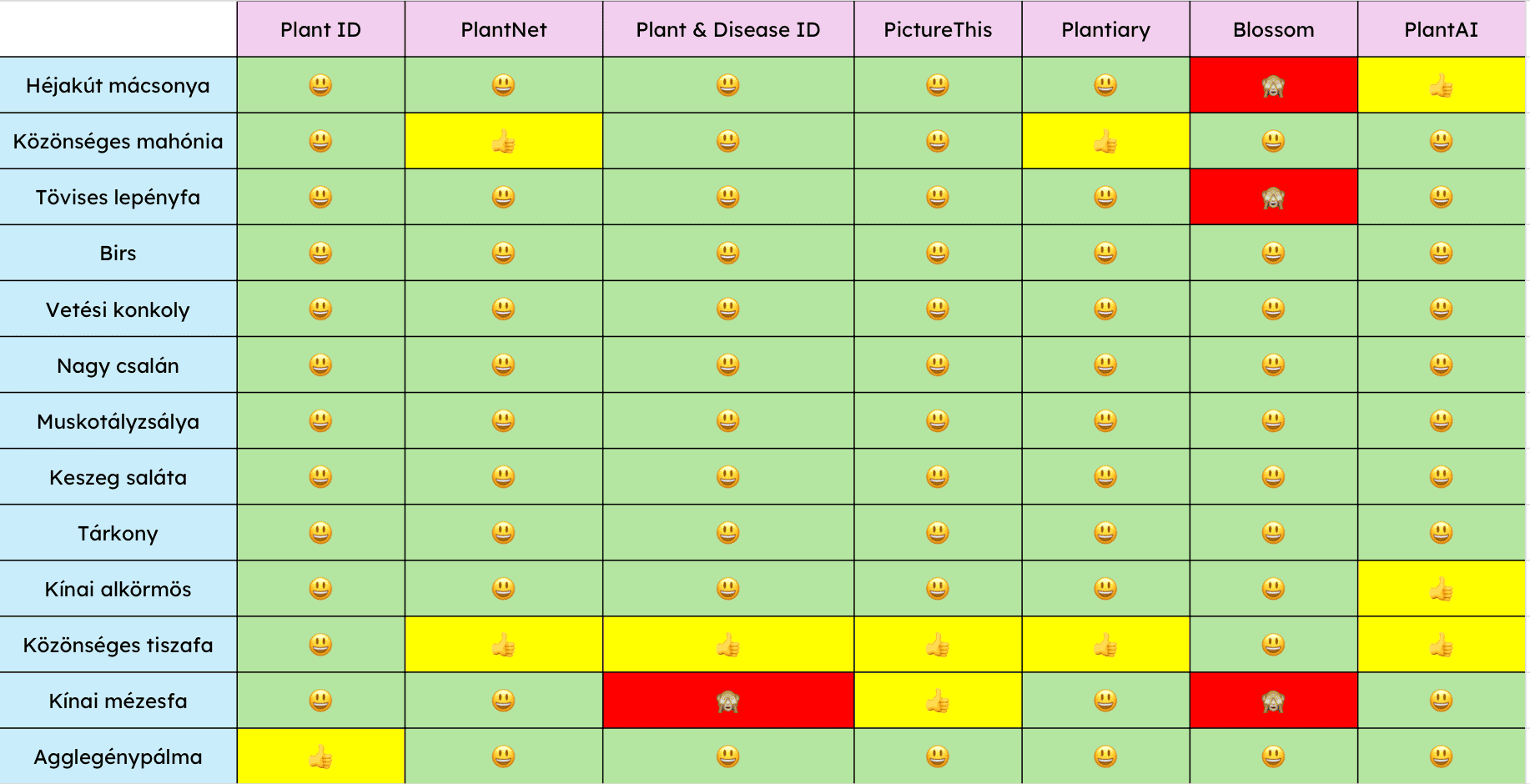
Plant ID had the best result, while Blossom had the worst. Plant ID made one small mistake, failing to define the bachelor palm at species level. Blossom, on the other hand, repeatedly associated with completely different species, e.g. Christmas tree-sage, buttercup-silkweed.
Plant recognition applications: prices, annual fees

Determining factor for applications which can range from 0 (PlantNet) to 155.000 HUF (Plantiary) per year.
Plant recognition applications: languages

Although the scientific names of definite plants are always the same, a good point, or other interfaces within the application it is particularly advantageous to have a Hungarian language.
Overall, if something is more expensive, it is not necessarily better. The resolutions are surprisingly accurate, with few big blunders. However, the species-level definitions still need to be treated with caveats.


 English (UK)
  Magyar