"The most beautiful trees grow from tiny seeds, and every seedling is the future",- unknown,The most enthusiastic gardeners have already started, or will very soon start, to grow their own vegetable seedlings. The main advantage of seedling production is that it can significantly speed up the development of long-lived, often frost-sensitive plant species and varieties. If you are an expert, you already know that this should be planned just as carefully as the seedling nursery.,The most important aspect when planning is the length of the growing period.,You should calculate this by taking 8 weeks off the sowing period written on the seed packet. Of course there are exceptions, for example, cabbages are ready in 6 weeks. However, it is not worth starting seedlings any earlier than this, as there are several dangers in planting too early:The ready seedlings need to be acclimatised to the weather outside, they need to be gradually moved to cooler and cooler places, tender seedlings grown indoors are vulnerable and can be easily broken by the wind, the development of early seedlings, which are very sensitive to heat, can be seriously hampered by the occasional cold spell, and frosts in May can ruin all the work you have done so far.,Moisture:,small amounts, rather just constant moisture. Light:,this is the biggest limitation of growing on a windowsill in a room, as most of the time there is little or very little light from one direction. In such cases, it seeks light and spends its energy on it, so it stretches and warps. It is useful to buy suitable seedling grow lights for this purpose.,The right temperature, which is slightly different for each species, averaging between 18 and 24 degrees, is ideal for most vegetable plants.,Phosphorus and the plant hormone auxin for root development. This is where several Danuba Garden products come into play, which specifically support rooting:,Asco Start,,Bio Bacteria,,at seed sowing,,to stimulate seed germination by irrigation,Why it is so important to support rooting,,greater root mass when growing seedlings,,greater water and nutrient uptake:,a more extensive root network allows our plants to take up more nutrients and water from much further and deeper in the soil. This allows it to provide water and nutrients to the plant during periods of nutrient deficiency or drought.,It will be more resistant to the weather,,,It will provide support.,Symbiosis with soil microorganisms: a healthy plant's root will release sugars into the soil that feed the fungi and bacteria living in the root zone. In return, these micro-organisms protect the plant from pathogens and help it to absorb nutrients. For planting, which Danuba Garden products can help?,,a naturally derived, micro-granulated organic fertilizer supported by three types of bacteria:,Priestia megaterium (,- makes bound phosphorus available to the plant, produces plant growth hormones, thus stimulating germination and rapid growth. Burkholderia,sp.,- Enables the availability of organic phosphorus in both acidic and alkaline soils. Increases the production of the hormone auxin, thus promoting rooting and rapid growth. It also produces chelating compounds.,mycorrhiza, which contains 6 different strains of mycorrhiza. Of these, the species that thrive best in that soil will proliferate in large quantities. The mycorrhizal fungal filaments grow into and through the root of the plant, increasing the root's capacity to absorb water and nutrients by a factor of about 700. It is an advantage to put mycorrhizae in the soil when sowing the seed, but it is also good to put them in later, when the seedlings are planted.Useful tips for growing seedlings,MikoMax Gardent,do not use it with fertiliser, as it creates a negative environment for mycorrhizae. If too much fertilizer, mainly phosphorus, is added to the plant at rooting, the plant will become stunted and will not take advantage of the lifelong help of mycorrhizae. In contrast, the organic nutrients in Asco Start Bio Bacteria can be released along with the seeds once they are in the ground, and algae irrigation is recommended to promote germination. It is made from marine algae and contains high doses of auxin substances. Auxin is the plant hormone primarily responsible for root development.,An upcoming newsletter will cover the topic of seedling nutrition and protection. – ismeretlen
1. Soaking seeds (optional)

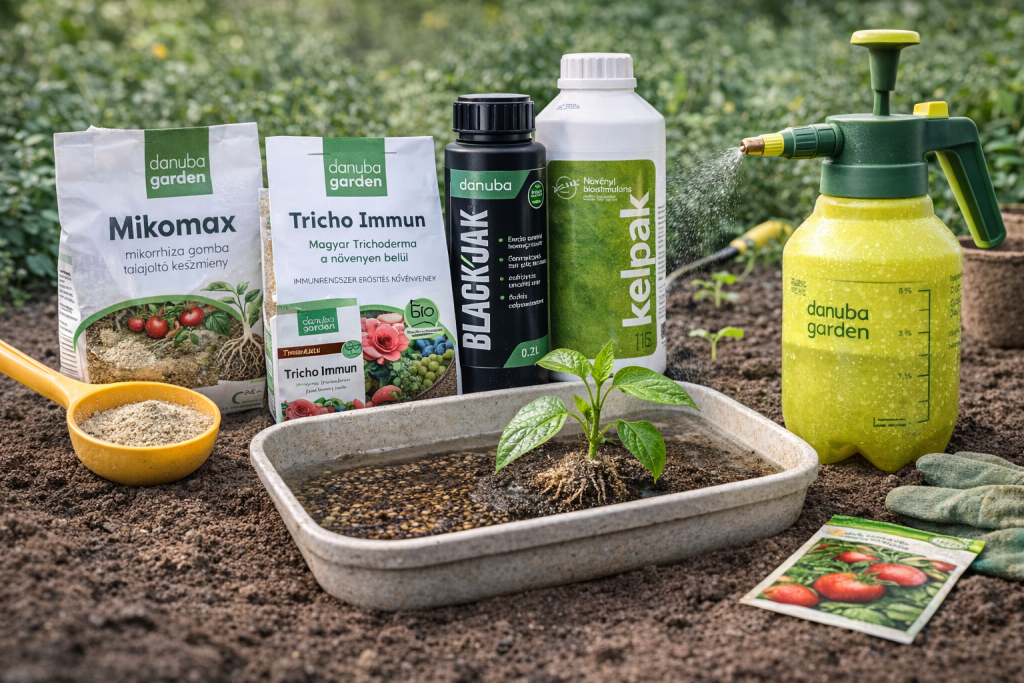
Soaking the seeds improves the success and speed of germination in many ways, although it is a somewhat laborious process:
- soaking softens the seed coat, the seed rises faster and more evenly
- better germination rate, especially for dry, hard-skinned seeds (e.g. peas, beans, beetroot, carrots, parsley)
- stronger initial development: the faster starting seedling more resistant, less sensitive to pathogens and soil stress.
1 dl of soaking water you should put the following:
- 1 ml Kelpak seaweed: supports germination due to its auxin plant hormone content
- 1-2 g Tricho Immun mushroom eater Trichoderma fungus: to prevent seedling dying
- 1 ml Blackjak
2. Seed sowing
After sowing, the emergence can be supported by the aforementioned combinationwatering.
3. Growing seedlings

Irrigating the soil or dressing the plant, in 1 l of water:
1x weekly with foliar spraying, in 1 l of water:
4. Spiking/spinning (optional)
By using staking, the plant can produce a better root system, stronger stems and higher yields.
Into the new, larger environment at planting you can:
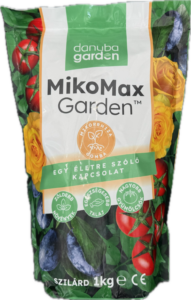
- Mikomax spray mycorrhiza directly under the root. A very small amount,
1-2 g is sufficient. - 2,5 ml Kelpak Spray 14 days after emergence or planting, then repeat every 3-4 weeks 2-3 times.
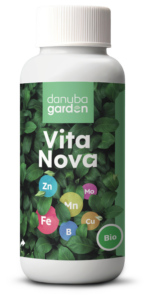
- VitaNova: plants are strengthened when they have access to trace elements (1 ml per 10 l of water).
Soil irrigation 10 ml Blackjak-with 1 litre of water
5. Outdoor planting
If you don't have any plastic wrap, planting should only be done after the frosts, around mid-May. If we have not yet MikoMax Garden under mycorrhizae, it is definitely worth it now. About a tablespoonful is enough for a planting hole.
First always the rootingconcentrates on the plant, which Kelpak can be supported by watering algae: 25 ml in 10 l of water. This treatment should be sprayed or watered 14 days after emergence or transplanting and repeated every 3-4 weeks 2-3 times.
Once the shoots have started to develop, you can start feedwith nutrients and Asco Algáfrom, and it is also the time to carry out the first preventive plant protection treatment. The recipe is as follows in 10 l of water:
For foliar spraying:
- 50 g Tricho Immun
- 2 dl Asco Alga
- 2 dl Blackjak
For soil irrigation: 1 dl Blackjak-with 10 litres of water
6. Early flowering

- Kelpak by spraying algae: 2 dl in 10 litres of water
- VitaNova with a micro-nutrient foliar fertiliser, in which boron is also a necessary element,
1 dl/10 l dose - 2 dl / 10 l water Blackjak foliage spraying
For soil irrigation: 1 dl Blackjak-with 10 litres of water
7. After flowering, a cyclically repeating treatment seriescan be weekly or fortnightly apply in rotation
- Softguard 2 dl in 10 litres of water to repel pests and fungi if fungal infestation or insect attack is predicted
- Asco Alga 2 dl in 10 litres of water for growing the crop, improving its texture and shelf life
- Blackjak 2 dl in 10 litres of water to improve the soil, replenish organic matter, improve nutrient utilisation and water retention
- Kelpak: 25 ml in 10 litres of water every 3-4 weeks
Alternating treatment means, for example, one week Asco Alga + Softguard, the next two weeks Kelpak + Blackjak. Here is a guide to which danuba garden products can be applied in a tank mix:

We would also like to introduce you to a new product that we do not use regularly, but rather on a judicious basis: MicrOil, a new oil-based detergent. It contains 98 % sunflower oil + nettle extract. Its special feature is that it is a so-called micro-emulsion, i.e. it is so fine that it helps to make otherwise insoluble water and oil miscible. After spraying, it creates a thinner oily film on the plant and therefore a much lower dosage is sufficient (30 ml in 10 litres of water) than conventional oils.
If you are dealing with aphids, mites or other typically small insect attacks, you can use this for control, it does not burn. Above 25 degrees and/or on hot days, we do not recommend it!

 Magyar
 English (UK)